

Your Restaurant Might Not Have a Staff Problem: It Could Be Something Else

If you've worked in hospitality for any length of time, you've probably said it yourself.
"Finding good staff is impossible."
"Nobody wants to work anymore."
"Why can't I keep chefs?"
These frustrations are real. Recruiting and retaining good people has become one of the biggest challenges facing hospitality businesses today.
But what if staffing isn't always the real problem?
Or perhaps more accurately...
What if it's only part of the problem?
After more than thirty years working in professional kitchens, I've learnt that many hospitality challenges are rarely caused by one thing alone.
Many restaurants don't necessarily have a staff problem.
Instead, it could be that good people are working within an environment that makes success far more difficult than it needs to be.
When Good People Work in Difficult Environments
Think about the last chef, supervisor or manager who left your business.
Did they leave because of one busy Friday night?
One difficult customer?
One stressful service?
Probably not.
People rarely leave because of a single bad shift.
More often, they leave because every shift gradually becomes harder than it needs to be.
Nobody is completely sure who is responsible for what.
People spend too much time asking questions they shouldn't need to ask.
Recipes live inside one person's head.
Equipment is never where it's expected to be.
Ordering depends on one individual remembering everything.
The same problems appear week after week because nobody has the time to solve the underlying cause.
Over time, even great people can become exhausted.
Not because hospitality is hard.
But because unnecessary complexity slowly becomes normal.
It Might Not Be the People
When owners tell me they have a staffing problem, they're often right.
Finding experienced chefs isn't easy.
Keeping great employees is even harder.
But sometimes the issue isn't simply finding better people.
It could be about making it easier for the people you already have to succeed.
Clear expectations.
Consistent routines.
Simple ways of working.
Shared knowledge instead of individual knowledge.
These may sound like small improvements, but together they create something much bigger.
They create an environment where people can do their best work instead of constantly firefighting.
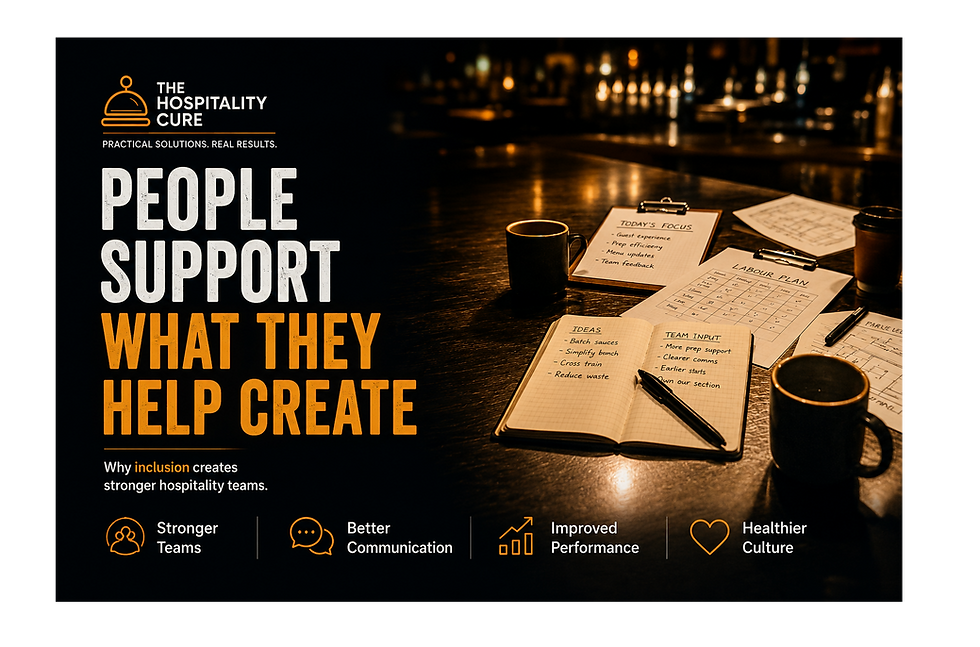
One lesson I've learnt over the years is that the best ways of working are rarely created by one person alone.
The strongest improvements usually come from listening to the people doing the job every day.
Your chefs, supervisors and front-of-house team often see frustrations, inefficiencies and opportunities long before management does. Giving people the opportunity to contribute doesn't weaken leadership, it strengthens it.
People are far more likely to support improvements when they understand them and feel they've helped shape them.
Three Questions Worth Asking
If you're wondering whether this could apply to your own business, ask yourself three simple questions.
Could a new chef confidently find everything they need without asking constant questions?
Could another team member comfortably cover every section if someone called in sick tomorrow?
If your Head Chef took two weeks off, would the kitchen continue operating with confidence?
If you answered "no" to any of these, it doesn't automatically mean you have a systems problem.
But it might be worth exploring whether your business has gradually become too dependent on individuals rather than shared ways of working.
Healthy Teams Are Built, Not Found
One of the principles behind The Hospitality Cure is simple:
People don't usually pull sickies from healthy cultures.
Of course, people still become genuinely ill, and life will always get in the way from time to time.
But when people feel supported, respected and genuinely part of the team, they're far less likely to call in simply because they can't face another shift.
Healthy cultures aren't built through motivational speeches or occasional staff perks.
They're built through clarity.
People knowing what's expected.
People having the tools they need.
People feeling heard.
People knowing their ideas matter.
People being able to do their job without constantly fighting unnecessary obstacles.
Busy services will always be busy.
Unexpected problems will always happen.
But a well-organised kitchen with a healthy culture feels very different from a chaotic one.
Good Systems Support Good People
The word systems can sometimes sound cold or overly corporate.
That isn't what I mean.
Good systems aren't endless paperwork.
They're simply practical ways of making work easier, more consistent and less stressful.
More importantly, they're there to support people—not control them.
The best kitchens I've worked in didn't succeed because they had perfect people or a manager with all the answers.
They succeeded because good people shared knowledge, trusted one another, and worked within clear, practical ways of working that everyone understood.
Before You Advertise Your Next Vacancy...
The next time you find yourself thinking,
"I just need better staff,"
pause for a moment and ask another question.
Could I make this a better place for good people to succeed?
Sometimes recruitment really is the answer.
But sometimes the greatest opportunity isn't finding different people.
It's creating an environment where the people you already have can thrive.
That journey rarely starts with finding all the answers.
More often, it starts by asking better questions.
Ready to Take a Fresh Look at Your Business?
The Hospitality Cure helps hospitality businesses identify unnecessary complexity, hidden operational pressure and practical opportunities for improvement.
Because sometimes the challenge isn't simply finding better people.
Sometimes it's about helping the people you already have succeed.


Comments